WarpFactory (Python)
A Python port of WarpFactory, a numerical toolkit for analyzing warp drive spacetimes using Einstein's theory of General Relativity. It reaches feature parity with the original MATLAB implementation, with a few deliberate physics-first fixes documented on the MATLAB Parity page.
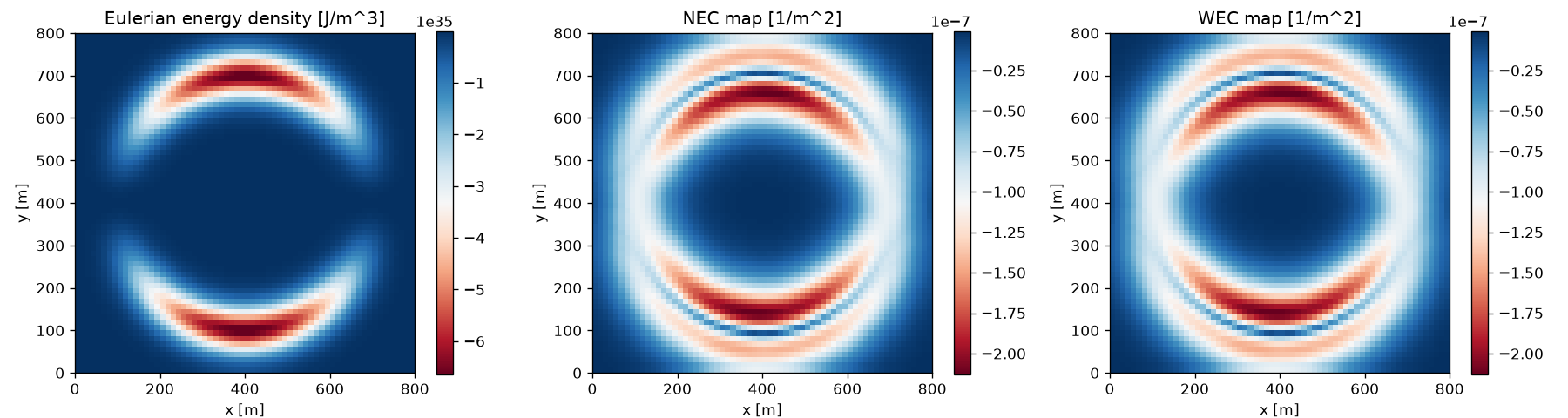
Eulerian energy density and Null/Weak energy-condition violation maps
for the Alcubierre metric with the WarpFactory paper's Section 4.1
parameters (v = 0.1c, R = 300 m, sigma = 0.015 1/m). Regenerate with
python examples/alcubierre_energy_conditions.py.
What it does
- Builds warp drive metrics on full 4-D grids and 1-D axial slices: Alcubierre, Lentz, Van Den Broeck, Modified Time (lab and comoving frames), TOV-based comoving Warp Shell, Schwarzschild, Minkowski, and custom metrics.
- Solves the Einstein field equations with 2nd/4th-order finite differences to obtain the stress-energy tensor.
- Evaluates the Null, Weak, Dominant, and Strong energy conditions by pointwise observer sampling in the local Eulerian frame.
- Computes curvature (Christoffel symbols, Ricci tensor/scalar, Kretschmann and Gauss-Bonnet invariants), kinematic scalars (expansion, shear, vorticity), geodesics, horizons, singularities, gravitational lensing, tidal forces, and the Ford-Roman quantum inequality bounds.
- Searches parameter spaces and minimizes exotic-matter requirements over metric ansatz families.
- Visualizes tensor components, energy densities, and momentum flows; includes an interactive Jupyter explorer.
Validation
Quantitative validation against the WarpFactory method paper
(Helmerich et al., CQG 2024; arXiv 2404.03095)
is committed as warpfactory/tests/test_paper_validation.py: the
Section 4.1 Alcubierre configuration reproduces the analytic peak
Eulerian energy density of -6.775e35 J/m^3 to 2% on a 64^3 grid at
12.5 m spacing (4th-order FD), and the energy-condition violations of
Table 1 are reproduced for the Alcubierre, Van Den Broeck, and
Modified Time metrics.
Where to start
- Installation -- pip, poetry, and the optional extras
- Quickstart -- from a metric to energy-condition maps in a dozen lines
- Interactive Explorer -- the Jupyter front end, with Binder and Colab links
- Applications -- curvature analysis, geodesics, horizons, lensing, tidal forces
- MATLAB Parity -- exactly how this port relates to the original
Citing
If you use WarpFactory in research, cite the method paper and this
port (see the repository CITATION.cff, or use the "Cite this
repository" button on GitHub):
@article{Helmerich2024WarpFactory,
  title   = {Analyzing warp drive spacetimes with {Warp Factory}},
  author  = {Helmerich, Christopher and Fuchs, Jared and Bobrick,
             Alexey and Sellers, Luke and Melcher, Brandon and
             Martire, Gianni},
  journal = {Classical and Quantum Gravity},
  volume  = {41},
  number  = {9},
  pages   = {095009},
  year    = {2024},
  doi     = {10.1088/1361-6382/ad2e42}
}